
2026 World Cup Final: Spain Beat Argentina 1-0 After Extra Time to Become World Champions
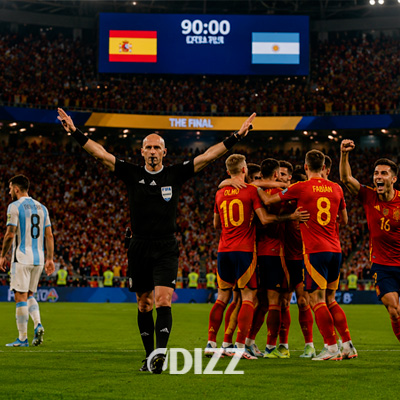
The 2026 FIFA World Cup Final delivered a dramatic conclusion as Spain defeated Argentina 1-0 after extra time at New York New Jersey Stadium in East Rutherford.
Neither team managed to score during regulation time, but Spain eventually found the breakthrough in the second period of extra time.
Ferran Torres scored in the 106th minute, giving his country the advantage that ultimately secured the championship.
For Spain, the victory represents their second men’s World Cup title after their historic first triumph in 2010. For Argentina, the defeat ended an impressive attempt to defend the championship they captured four years earlier.
Start following one of the most important events in international football as the 2027 FIFA Women’s World Cup heads to Brazil.
2026 FIFA World Cup Final Match Details 📝
- 🏆 Competition: FIFA World Cup 2026
- 🥇 Final Score: Spain 1-0 Argentina
- ⏱️ Result: After extra time
- ⚽ Goal: Ferran Torres, 106th minute
- 📅 Date: Sunday, July 19, 2026
- 🏟️ Venue: New York New Jersey Stadium
- 📍 Location: East Rutherford, New Jersey
The championship match completed the expanded 48-team World Cup and ended with Spain lifting the trophy for the first time in sixteen years.
Spain Take Control of a Difficult World Cup Final 🇪🇸
From the opening stages, Spain attempted to establish control through possession and patient ball circulation.
Rather than forcing passes into crowded areas, the Spanish midfield moved the ball across the pitch and waited for opportunities to appear.
Argentina responded with a compact defensive structure designed to protect central spaces and prevent Spain’s creative players from receiving possession close to goal.
As the minutes passed, their territorial advantage increased. Argentina continued defending effectively, but their limited attacking production meant Spain could commit more players forward.
Argentina’s Defensive Resistance Keeps the Final Scoreless 🛡️
Despite spending significant periods without possession, Argentina remained extremely difficult to break down.
Cristian Romero and the rest of the defensive unit protected the penalty area, while goalkeeper Emiliano Martínez provided another confident presence behind the back line.
Spain attempted to create openings through combinations in wide areas and quick movements around the penalty box, but Argentina repeatedly closed the available spaces.
The defensive effort was enough to keep the score at 0-0 after ninety minutes, sending the World Cup Final into extra time.
However, Argentina’s lack of attacking threat eventually became a major problem.
Without sustained possession in advanced areas, the defending champions were forced to absorb increasing pressure.
Ferran Torres Changes the World Cup Final ⭐
With both teams beginning to show signs of fatigue, substitutions became increasingly important.
Spain’s squad depth ultimately produced the decisive moment.
Ferran Torres, introduced from the bench, found the breakthrough in the 106th minute. His goal finally ended Argentina’s resistance and completely changed the tactical situation.
Argentina suddenly needed to attack after spending much of the match focused on defensive organization.
Spain, meanwhile, could protect their advantage through possession and intelligent game management.
Torres’ goal eventually became the defining moment of the entire tournament.
Spain’s Defensive Organization Neutralizes Argentina ⚔️
While the winning goal naturally received most of the attention, Spain’s defensive performance was equally important.
Argentina struggled to consistently involve their attacking players in dangerous positions.
Spain maintained compact distances between midfield and defense, reducing opportunities for Lionel Messi and his teammates to operate between the lines.
Whenever Argentina attempted to progress forward, Spain quickly reorganized behind the ball.
The result was an unusually quiet attacking performance from a team that had scored regularly throughout the knockout rounds.
Spain’s ability to combine attacking control with defensive discipline became one of the clearest reasons they finished the tournament as champions.
Lionel Messi’s Argentina Fall One Match Short 🇦🇷
Argentina entered the final hoping to accomplish something extremely rare in modern international football: winning consecutive World Cups.
After lifting the trophy in 2022, Lionel Scaloni’s team returned to the final four years later and once again demonstrated remarkable consistency throughout the tournament.
However, Spain presented a completely different tactical challenge.
Messi found limited space in advanced positions, while Argentina struggled to create the combinations that had made their attack so dangerous earlier in the competition.
Even though the final ended in disappointment, reaching consecutive championship matches represents an extraordinary achievement for this Argentine generation.
Extra-Time Drama Defines the Championship ⏱️
The final entered extra time with both teams still searching for the opening goal.
At that stage, physical conditioning and squad depth became increasingly important. Spain continued pushing forward while Argentina attempted to maintain their defensive structure.
Ferran Torres’ breakthrough forced Argentina to abandon their cautious approach.
The defending champions attempted to respond during the remaining minutes, but their challenge became even more complicated when Enzo Fernández was sent off.
Spain used their numerical advantage and possession quality to manage the closing stages and protect their narrow lead until the final whistle.
Spain Celebrate Their Second World Cup Title 🏆
Spain’s victory places another championship alongside the country’s unforgettable 2010 triumph.
Interestingly, both Spanish World Cup titles were secured through 1-0 victories after extra time in the final.
In 2010, Andrés Iniesta scored against the Netherlands.
Sixteen years later, Ferran Torres became the player responsible for another championship-winning goal beyond the regulation ninety minutes.
The 2026 victory also confirms the emergence of another exceptional generation of Spanish players capable of competing for the biggest trophies in international football.
Explore the next chapter of football’s biggest tournament. See how the 2030 World Cup will celebrate 100 years of FIFA World Cup history.
Spain’s Impressive Road to the 2026 World Cup Trophy 🛣️
Spain produced an outstanding run through the knockout rounds.
Their path to becoming champions included:
- Round of 32: Spain 3-0 Austria
- Round of 16: Spain 1-0 Portugal
- Quarterfinal: Spain 2-1 Belgium
- Semifinal: Spain 2-0 France
- Final: Spain 1-0 Argentina after extra time
Perhaps the most impressive aspect of the campaign was Spain’s defensive consistency.
Across five knockout matches, they conceded only one goal and recorded four clean sheets, including shutouts against Portugal, France, and Argentina.
Argentina’s Journey to Another World Cup Final 🌎
Argentina also produced an impressive knockout-stage campaign before falling at the final hurdle.
Their results included:
- Round of 32: Argentina 3-2 Cape Verde
- Round of 16: Argentina 3-2 Egypt
- Quarterfinal: Argentina 3-1 Switzerland
- Semifinal: Argentina 2-1 England
- Final: Spain 1-0 Argentina after extra time
Argentina entered the championship match having scored multiple goals in every knockout game.
Spain became the first opponent in the elimination rounds to completely prevent them from scoring. That contrast ultimately defined the final.
What the 2026 World Cup Victory Means for Spain 🌟
The championship represents confirmation that Spain have returned to the summit of world football.
Their success was built around technical quality but also demonstrated an evolution from previous Spanish teams.
The 2026 champions combined possession with direct attacking play, aggressive pressing, pace on the wings, and an exceptionally organized defense.
Young talents and established stars contributed throughout the competition, while squad depth became decisive when Ferran Torres emerged from the bench to score the championship goal.
The final may have been decided by a single goal, but Spain’s performance throughout the tournament demonstrated why they deserved to lift the trophy.
After sixteen years, Spain are FIFA World Cup champions once again.
FAQ
1. Who won the 2026 FIFA World Cup?
- Spain won the tournament after defeating Argentina 1-0 after extra time in the final.
2. Who scored in the 2026 World Cup Final?
- Ferran Torres scored the only goal of the match in the 106th minute.
3. How many World Cup titles does Spain have?
- Spain have won two men’s FIFA World Cups, capturing the trophy in 2010 and 2026.
4. Why did the World Cup Final go to extra time?
- Spain and Argentina finished regulation time tied 0-0, requiring an additional thirty minutes to determine the champion.
5. Where did Spain vs Argentina take place?
- The 2026 FIFA World Cup Final was played at New York New Jersey Stadium in East Rutherford, New Jersey, on July 19, 2026.
