
Negotiate a ChatGPT Enterprise subscription with the governance and security terms you actually need
A ChatGPT Enterprise subscription is designed for organizations that need stronger governance, identity management and data controls as AI use expands across teams.
Instead of a public per-seat price, Enterprise uses custom commercial terms and can include features such as SCIM, role-based access controls and configurable data retention.
That makes it important to define your security, residency, support and contract requirements before speaking with sales or comparing Enterprise with lower-tier plans.
Evaluate identity, privacy, integrations and long-term cost as one decision, not a series of separate checkboxes. OpenAI’s official documentation and the signed order form are the sources that count; anything not written there, retention defaults, residency region, support response times, should be negotiated and documented.
Why do organizations move to an enterprise AI agreement? 🔎
Companies usually reach this point when they need more control than a team plan offers: automated user provisioning, custom data retention, specific residency requirements or contractual support commitments.
The deciding factor is often governance, not the number of employees, a smaller organization in a regulated industry may need Enterprise sooner than a larger one without those constraints.
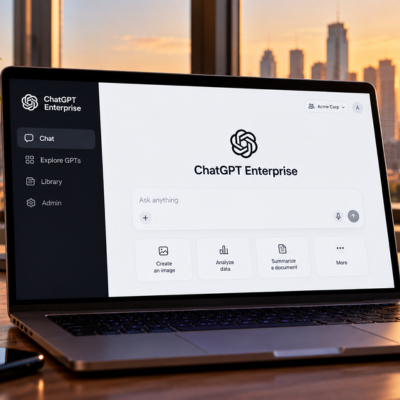
ChatGPT Enterprise capabilities at a glance 📊
The table summarizes the verified characteristics of the Enterprise offering. Use it as a checklist for your requirements document; the final scope and price are defined in your custom quote.
| Criterion | Verified point |
| Pricing | custom quote |
| Identity | SAML SSO, SCIM and role-based controls |
| Security | enterprise privacy and administrative controls |
| Data | custom retention and data residency options |
| Operations | priority support and service terms |
| Fit | deployments needing custom governance, retention and support terms, regardless of headcount |
Enterprise vs. team plans: how to weigh the options 🧭
Compare Enterprise with lower-tier plans, and with competing enterprise AI platforms, using the same user base, the same contract length and the same compliance requirements.
Keep in mind that a lower per-user price may exclude support levels or integrations your IT team depends on; pilots rarely capture full-scale usage; and some governance features may sit behind specific contract terms.
Build a requirements matrix and keep it updated through negotiations: each control you need, whether it’s included, who confirmed it and when. That document becomes invaluable during security review and at renewal time.
| Criterion | Verified point | How to use it? |
| Need | workflow and measurable outcome | define success first |
| Access | users, roles and MFA | avoid shared credentials |
| Cost | licence, add-ons and labour | calculate total cost |
| Exit | exports and retention | test portability early |

Contract terms, integration effort and governance risk ⚖️
Beyond the negotiated license fee, plan for identity integration (SSO and SCIM setup), security and legal review, change management and training, internal policy development and the potential cost of exporting data or switching providers in the future.
The main risks are governance gaps: unclear retention settings, overly broad admin permissions and shadow AI use that continues outside the approved workspace.
Define roles carefully, document your data policies and be cautious of intermediaries offering “enterprise access” outside an official agreement with OpenAI.
From requirements to signed contract ✅
Start by defining the business outcomes you expect and the compliance requirements you can’t compromise on, for example, data residency, SCIM provisioning and a specific retention period.
Run a pilot with representative teams, measure results and compare Enterprise with at least one alternative under the same requirements.
Before signing, review retention, residency, support commitments, renewal pricing and exit provisions. Model costs for broader adoption than your pilot: if the value case holds up, you’re ready to scale.
- Write down your compliance and governance requirements.
- Confirm SAML SSO and SCIM fit your identity stack.
- Define data retention and residency needs.
- Run a pilot with representative departments.
- Build a requirements matrix for negotiation.
- Assign admin roles on a least-privilege basis.
- Negotiate support terms and renewal pricing.
- Archive the order form and all written confirmations.
FAQ ❓
- How is a ChatGPT Enterprise subscription priced?
- Through a custom quote. The price depends on your scope, terms and requirements, so prepare a clear list of needs, identity, retention, residency and support, before talking to sales.
- How should we estimate the total cost of an enterprise AI rollout?
- Combine the negotiated license fee with integration work, security and legal review, training, policy development and ongoing administration. Compare that total with the productivity gains measured in your pilot.
- What red flags should we watch for in enterprise AI procurement?
- Intermediaries selling unofficial access, vague data-handling commitments, contracts without clear retention or exit terms and pressure to sign before security review is complete.
- When should we revisit our Enterprise agreement?
- Before each renewal, when adoption expands significantly, when new regulations affect your data handling or when your identity or security stack changes.
- Where can we find public guidance on business contracts and scams?
- Although aimed at a broad audience, FTC Consumer Advice offers useful red-flag lists; use them as a sanity check on the terms negotiated in your ChatGPT Enterprise agreement.
